Financial markets don’t run themselves. Behind every trade is a network of participants — each with different goals, different resources, and different roles in keeping the market functioning. As a quant developer, you’ll build systems that interact with many of these participants, so understanding who they are and what they do is essential.
Exchanges
Exchanges are the infrastructure of financial markets. They provide the venue where buyers and sellers meet, maintain the central order book, and ensure trades are executed fairly and transparently.
Examples include the ASX (Australian Securities Exchange), NYSE (New York Stock Exchange), HKEX (Hong Kong Exchanges and Clearing), and CME (Chicago Mercantile Exchange for derivatives).
Exchanges set the rules — trading hours, tick sizes, order types, and market phases like pre-open auction and continuous trading. As a quant dev, you’ll often be writing code that connects directly to exchange infrastructure.
Clearing Houses
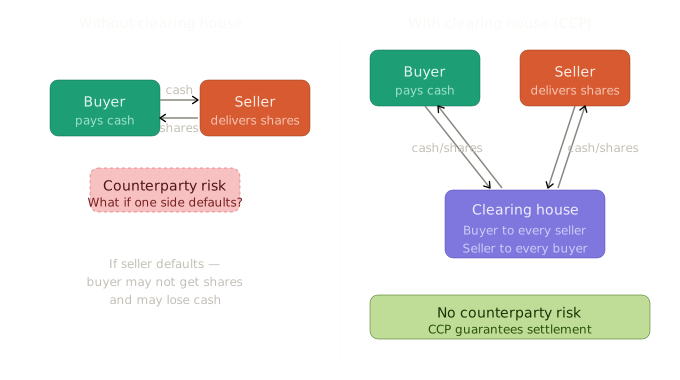
When a trade is executed on an exchange, someone needs to guarantee that both sides of the trade will be honoured — that the buyer actually receives the shares and the seller actually receives the cash. That’s the role of the clearing house, also known as a Central Counterparty (CCP).
The clearing house steps in between the buyer and seller, becoming the buyer to every seller and the seller to every buyer. This eliminates counterparty risk — the risk that the other side of your trade defaults before settlement.
Examples include ASX Clear (Australia), LCH (London), CME Clearing (US), and HKEX OTC Clear (Hong Kong).
Clearing houses also manage margin requirements — requiring participants to post collateral proportional to their open positions. This is why pre-trade risk checks in trading systems need to account for available margin before sending orders.
For quant developers, clearing house interactions matter in several areas — post-trade processing, margin calculation, settlement systems, and regulatory reporting. Understanding how clearing works helps you build more robust execution and risk infrastructure.
Brokers and Prime Brokers
Brokers act as intermediaries between clients and exchanges. When a hedge fund wants to buy shares, it typically goes through a broker who routes the order to the exchange on their behalf.
Prime brokers are a more comprehensive service offered by large investment banks — they provide hedge funds with financing, securities lending, trade execution, and reporting all in one place. Goldman Sachs, Morgan Stanley, and JP Morgan are well-known prime brokers.
Market Makers
Market makers are firms that continuously quote both a buy price (bid) and a sell price (ask) for a security. They don’t wait for a matching buyer and seller to appear at the same time — instead they trade with whoever arrives, one side at a time.
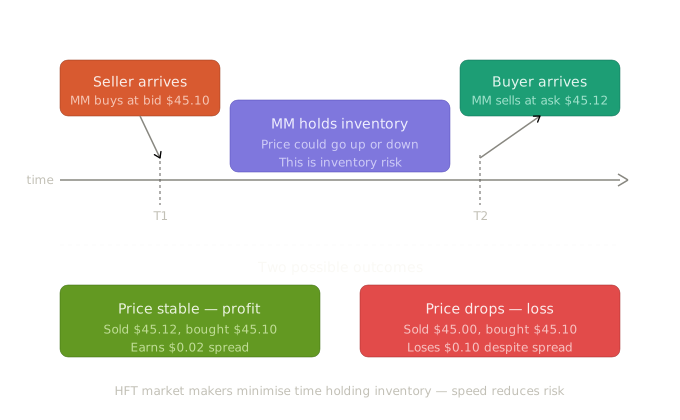
When a seller arrives, the market maker buys from them at the bid price and holds the shares as inventory. When a buyer arrives later, the market maker sells to them at the ask price. The $0.02 spread between bid and ask is the intended profit.
But it’s not free money. While holding inventory between the two trades, the market maker is exposed to inventory risk — if the price moves against them before they can offload the position, they lose more than the spread earns. A market maker who buys shares at $45.10 and watches the price drop to $45.00 before selling loses $0.10 despite earning a $0.02 spread.
This is why speed is so critical in high-frequency market making. The faster you can turn over inventory — finding the other side of the trade — the less time you’re exposed to price risk. Firms like Citadel Securities, Virtu Financial, and IMC invest heavily in ultra-low latency infrastructure to minimise this exposure.
For quant developers, this means the systems you build directly affect the firm’s risk profile. A microsecond improvement in execution speed isn’t just a performance metric — it’s a risk management tool.
Hedge Funds
Hedge funds are investment funds that use a wide range of strategies to generate returns — including quantitative strategies driven by algorithms. They are major consumers of market data and execution infrastructure.
Quant hedge funds like Two Sigma, DE Shaw, and Renaissance Technologies employ large teams of quant developers to build and maintain their trading systems.
Investment Banks
Investment banks serve multiple roles — they underwrite IPOs, facilitate large institutional trades, run their own proprietary trading desks, and provide research and advisory services. Their quant dev teams build everything from pricing libraries to risk systems to execution platforms.
Retail Investors
Individual investors trading through platforms like CommSec, Interactive Brokers, or Robinhood. While their individual trades are small, in aggregate retail flow is significant and increasingly a focus of market microstructure research.
Regulators
Regulators oversee markets to ensure fairness, transparency, and stability. In Australia that’s ASIC (Australian Securities and Investments Commission). In the US it’s the SEC (Securities and Exchange Commission) and CFTC (for derivatives). Exchanges and participants must comply with regulatory requirements — which affects everything from order audit trails to risk controls that quant developers build.
Why This Matters for Quant Developers
The systems you build will interact with this ecosystem constantly. Your market data feed comes from exchanges. Your orders flow through brokers. Your risk systems protect the firm from losses. Your execution algorithms compete with market makers.
Knowing who the players are helps you understand why the systems are designed the way they are — and why performance, reliability, and precision are non-negotiable.
In the next article we’ll look at the different asset classes traded across these markets.