Financial markets trade many different types of instruments. Each one has different characteristics, different participants, and different technical requirements for the systems that support it. As a quant developer, understanding asset classes helps you understand why the systems you build are designed the way they are.
What Is an Asset Class?
An asset class is a group of financial instruments that share similar characteristics — how they’re priced, how they’re traded, and what rights or obligations they represent. Different asset classes trade on different venues, at different speeds, and with different levels of complexity.
Equities
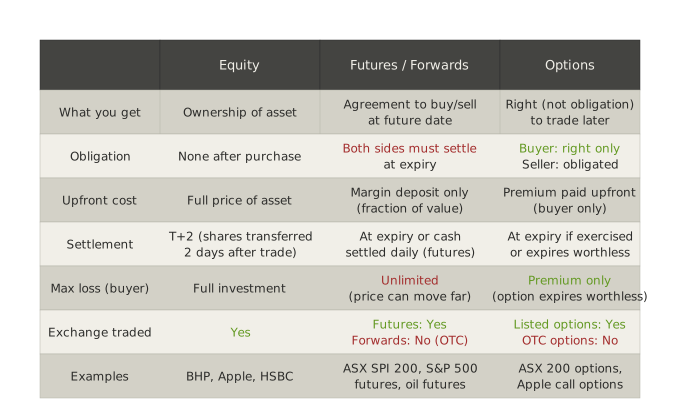
Equities — also known as stocks or shares — represent ownership in a company. When you buy a share of BHP or Apple, you own a small fraction of that company and are entitled to a share of its profits (dividends) and voting rights.
Equities trade on centralised exchanges like the ASX, NYSE, and HKEX. They are among the most liquid instruments in the world, with millions of trades happening every day.
For quant developers, equities are often the starting point. The infrastructure is well understood, market data feeds are standardised, and there is a large ecosystem of tools and libraries. Many HFT firms began in equities before expanding to other asset classes.
Fixed Income
Fixed income instruments — primarily bonds — represent a loan made by an investor to a borrower (a government or corporation). The borrower pays regular interest (the coupon) and returns the principal at maturity.
Government bonds (like Australian Commonwealth bonds or US Treasuries) are among the most heavily traded instruments in the world by value. They tend to trade OTC rather than on centralised exchanges, which creates different technical challenges for quant devs — particularly around price discovery and connectivity.
Foreign Exchange (FX)
FX is the market for trading currencies — buying USD and selling AUD, for example. It is the largest financial market in the world by volume, with over $7 trillion traded daily.
FX is almost entirely OTC, meaning trades happen directly between participants rather than through a central exchange. Major participants include banks, hedge funds, corporations, and central banks.
For quant developers, FX presents interesting challenges around latency, liquidity aggregation across multiple venues, and the 24-hour nature of the market.
Futures and Forwards
A futures contract is an agreement to buy or sell an asset at a predetermined price at a future date. Futures trade on centralised exchanges (like CME or ASX 24) and are standardised — fixed contract sizes, fixed expiry dates.
Forwards are similar but traded OTC — customisable but with counterparty risk.
Futures are widely used for hedging (managing risk) and speculation. Common futures include:
- Equity index futures — track a stock market index (e.g. ASX SPI 200 tracking the ASX 200, S&P 500 futures, Hang Seng futures). Heavily traded by HFT firms.
- Single stock futures — futures on individual company shares
- Commodity futures — oil, gold, wheat, natural gas
- Interest rate futures — based on government bond yields or short-term interest rates
- FX futures — standardised currency contracts traded on exchange
For quant developers, futures are particularly interesting because they combine exchange-traded infrastructure (standardised, central order book) with derivatives complexity (expiry dates, rollovers, basis risk). Many HFT firms are very active in futures markets.
Options and Derivatives
An option gives the buyer the right — but not the obligation — to buy (call option) or sell (put option) an asset at a fixed price before a certain date. Options are priced using mathematical models that account for the current price, time to expiry, volatility, and interest rates.
Options come in several forms:
- Stock options — options on individual company shares (e.g. Apple call options)
- Index options — options on a stock market index (e.g. ASX 200 options, S&P 500 options). Very heavily traded, especially by institutional investors for hedging
- ETF options — options on exchange-traded funds
- FX options — options on currency pairs
- Interest rate options — options on bond yields or rate instruments
Warrants are similar to options but issued directly by a company or financial institution rather than traded on an exchange. They give the holder the right to buy shares at a fixed price and are commonly listed on the ASX. Structured warrants issued by banks are popular with retail investors in Hong Kong and other Asian markets.
Derivatives is a broader category that includes options, futures, swaps, and other instruments whose value is derived from an underlying asset.
Options desks are among the most technically demanding environments for quant developers — requiring real-time pricing models, Greeks calculations, volatility surface management, and sophisticated risk systems.
Which Asset Classes Matter Most for Quant Devs?
The answer depends on which type of firm and role you’re targeting:
Equities — most HFT market making firms, delta 1 desks, and stat arb funds. Good entry point, well-understood infrastructure, lots of job opportunities.
Futures — very active HFT space, CME and other derivatives exchanges. Similar low-latency infrastructure to equities but with added complexity around expiry and roll.
Options — options market making firms (Optiver, IMC, Citadel Securities). Requires deeper understanding of pricing models and Greeks. Higher complexity, higher compensation.
FX — large banks and specialist FX firms. OTC nature means different connectivity challenges. Less HFT-focused than equities/futures but still technically demanding.
Fixed income — investment banks and macro hedge funds. Less HFT-focused, more about analytics and risk systems.
If you’re targeting a quant dev role and don’t have a strong preference, equities and futures are the best starting point — the infrastructure is well documented, interview questions are well defined, and the job market is the largest.
In the next article we’ll look at how exchanges actually work — trading hours, market phases, and the mechanics of order matching.